

Somewhere in the world a child dies of pneumonia every 43 seconds.
Yet in Kilifi County on Kenya’s coast, the disease caused by the pneumococcal strains that the national vaccine targets has fallen by 91 per cent among children under five since the vaccine arrived in 2011, once researchers account for the decline that was already under way.
The gap between those two realities was the subject of a Ministry of Health webinar on World Pneumonia Day 2026, convened by the National Vaccines and Immunization Programme (NVIP) to mark fifteen years of the pneumococcal conjugate vaccine (PCV) in Kenya, with speakers moving from national statistics to a coastal county’s clinics and then to the laboratory data that connect the two.
Edwina Anyango, the NVIP coordinator who moderated, explained that understanding the disease matters for advocacy, because communities are far more likely to embrace childhood vaccination when they appreciate why preventing pneumonia is so important.
A burden that is falling, though not quickly enough
According to Alex Mutua, a programme manager in the newborn and child health section of the Ministry’s Division of RMNCAH, the Kenya Mini Demographic and Health Survey 2025 puts under-five mortality at 37 deaths per 1,000 live births, infant mortality at 30 and neonatal mortality at 19.
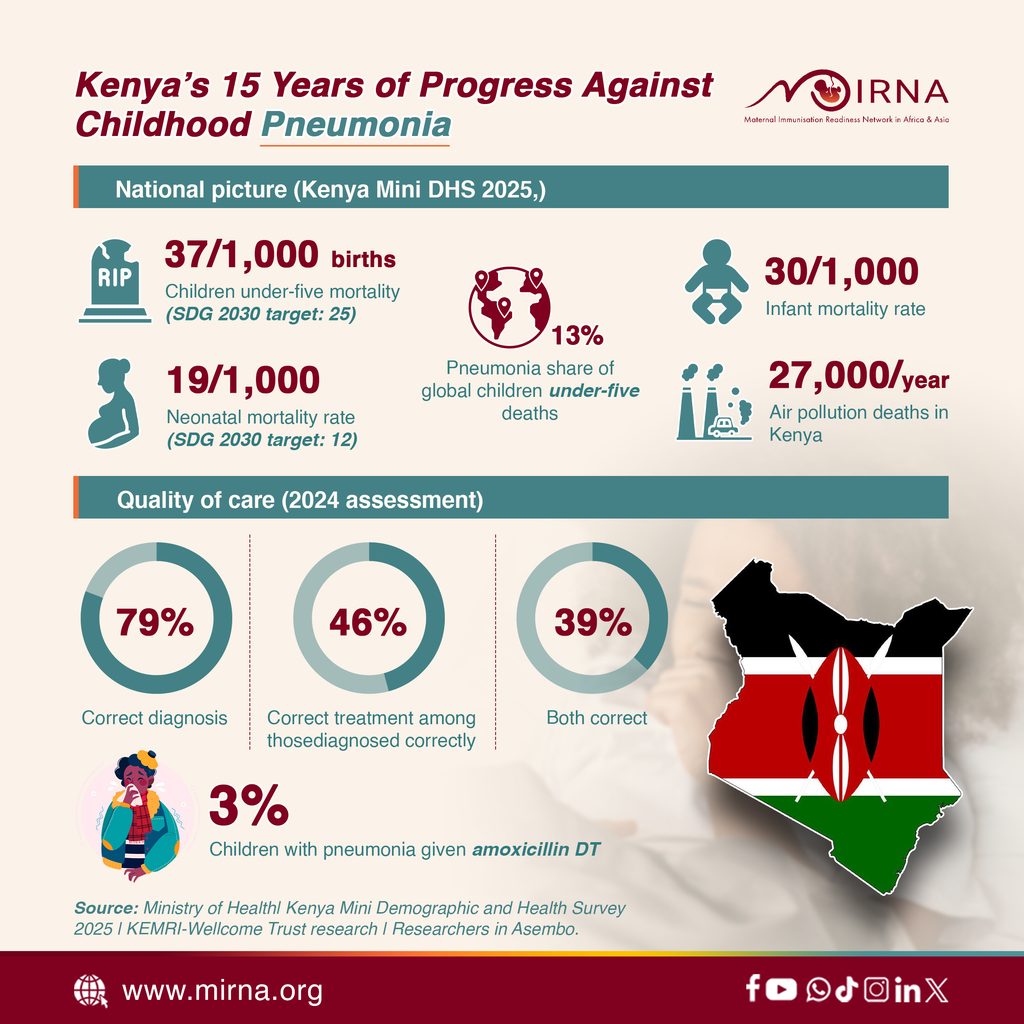
Against those figures, the Sustainable Development Goal targets for 2030 are 25 deaths per 1,000 live births for under-fives and 12 for newborns, which leaves a gap of 12 and 7 deaths per 1,000 live births respectively to close in the roughly four years that remain.
With roughly four years remaining, he told participants that the country needs “a lot of concerted effort” directed at high impact interventions.
Globally, he said, pneumonia accounts for 13 per cent of deaths among children under five, and since between 45 and 47 per cent of under-five deaths are attributed to neonatal causes, newborns need as much attention as older children.
“Pneumonia is preventable and is treatable,” Mutua said, and he placed vaccines at the centre of prevention. National coverage figures from the 2025 survey are impressive, with the first, second and third doses of PCV reaching 98, 97 and 92 per cent, and pentavalent coverage standing at 98, 95 and 90 per cent. He cautioned that these are national averages and that some counties will sit below them.
The causes of pneumonia deaths, he explained, reach well beyond the lungs, running through undernutrition, poor water and sanitation, and indoor and outdoor air pollution, which he linked to around 27,000 deaths a year in Kenya. Many facilities lack pulse oximeters, face stock-outs or run short of staff, and caregivers often arrive late after trying over-the-counter remedies and herbal concoctions at home.
Where the system loses children
The most sobering part of Mutua’s presentation drew on a 2024 quality of care assessment of nurses, doctors and clinical officers. Only 79 per cent of the health workers assessed made the correct diagnosis, only 46 per cent of those gave the right treatment, and just 39 per cent managed both. “So, you can see there is a really big gap in terms of capacity for healthcare workers,” he said, adding that the Ministry is responding with training in integrated management of newborn and childhood illness and with on-site mentorship.
The correct treatment for non-severe pneumonia is amoxicillin dispersible tablets, given at 40 mg per kg per day in two divided doses for five days, with a review within 48 hours, yet data he cited showed that only 3 per cent of children diagnosed with pneumonia received that drug. Children with severe pneumonia need admission and, as first-line treatment, penicillin with gentamicin, and any child whose oxygen saturation falls below 90 per cent should receive oxygen. “No child to die because oxygen is not available,” he said, as part of a call to action.
Mutua also spoke candidly about antibiotic resistance, noting that research at KEMRI-Wellcome Trust under Professor Agweyu shows that many pneumonia cases are caused by viruses such as RSV and do not need antibiotics. He described mothers asking kiosks and pharmacies for “amoxicillin of 20 bob, 50 bob”, buying a fraction of a course that is rarely completed.
Lessons from the coast
Christine Mataza, the Kilifi County Expanded Programme on Immunization (EPI) coordinator, who brings more than three decades of nursing and public health experience, described how the vaccine reaches children across a county of about 1.8 million people and seven sub-counties. Of Kilifi’s 380 health facilities, 54 per cent are private and 191, or 50.3 per cent, offer vaccination, supported by 319 community health units serving around 61,000 children under one.
PCV10, the 10-valent pneumococcal conjugate vaccine commonly sold as Synflorix, an injectable vaccine that protects infants and young children against invasive pneumococcal disease, pneumonia and acute otitis media caused by ten specific serotypes of Streptococcus pneumoniae, and it arrived in Kenya in 2011 with a catch-up campaign that covered every child under five in Kilifi.
The vaccine is given at six, ten and 14 weeks, and delivery runs through health facilities and outreach clinics, where monthly reviews identify dropouts and missed doses, while sub-counties meet every quarter to examine their performance and community health promoters trace defaulters. Faith networks, schools and local leaders help to carry immunisation messages into households, and last-mile vaccine distribution has spared health workers the journey to collect supplies, a saving that matters in a county as vast as Kilifi.
She was equally frank about the difficulties of a vast county, from remote communities and cold chain breakdowns to delays in equipping new facilities and, in some places, a single health worker running an entire facility. Stock-outs carry a cost beyond the clinic, because a mother who finds one antigen missing tells her peers, who conclude that no vaccines are available at all. Mataza was clear about what the vaccine has delivered, observing that clinics now see very few children with severe pneumonia, and she closed with a line that captured the whole programme: “every dose counts.”
Fifteen years of evidence
Dr John Ojal, a research scientist at the KEMRI-Wellcome Trust Research Programme in Kilifi, and his team have tracked invasive pneumococcal disease (IPD) at Kilifi County Hospital since 1999, linking hospital and laboratory records to a population register. Before vaccination, the incidence among children aged two to 59 months was about 81 per 100,000 a year, of which roughly 60 came from strains the vaccine protects against, and admissions for severe and very severe pneumonia in the early 2000s ran at about 2,000 per 100,000 children annually.
The raw figures fell to about 12 per 100,000 for all strains and about two for vaccine strains, but Ojal urged caution: “I don’t take these numbers at face value.” Disease was already declining before the vaccine, so he adjusted for the background trend, which attributes a 68 per cent reduction in all IPD, and 91 per cent in vaccine-type IPD, to the vaccine. Non-vaccine strains rose by an estimated 25 per cent, an estimate he described as unstable.
The benefits reached beyond bloodstream infections, with radiologically confirmed pneumonia in under-fives falling by about 48 per cent, severe clinical pneumonia by 40 per cent and all clinical pneumonia by about 27 per cent. Studies by KEMRI and the US Centers for Disease Control and Prevention in Asembo and Kibera, in western Kenya, found carriage of vaccine-type pneumococcus in the nose and throat falling from highs of about 30 and 40 per cent to roughly 10 per cent.
Unvaccinated adults gained too. In Kilifi, vaccine-type IPD among people over 15 dropped by about 83 per cent, and IPD of any strain by 38 per cent, while researchers in Asembo estimated an 87 per cent reduction in pneumococcal pneumonia.
What remains
“We’ve not yet eliminated” the disease, he said Ojal, adding that about 20 per cent of the IPD now seen in Kilifi would still be covered by Synflorix, the vaccine used until 2022. Pneumosil, the current vaccine, would cover about 40 per cent, and a 21-valent vaccine could cover up to 60 per cent of strains in under-fives. He framed the choice as one of cost as much as science, since higher-valency vaccines are expensive and the programme is already struggling to sustain its funding.
When a participant, Clement, asked why some vaccine-type disease persists, Ojal answered that “the vaccine itself is not 100% efficacious”, so some breakthrough disease is expected even against strains it targets.
In the closing discussion Anyango described how Kenya moved from Synflorix to Pneumosil, which comes in multi-dose vials usable for 28 days if the vaccine vial monitor, expiry date, aseptic technique and storage rules are respected, with wastage normally around 10 per cent. Children who miss doses should be caught up with three doses at four-week intervals without restarting the series. Asked about the relationship with RSV, a pipeline vaccine for which the programme’s roadmap favours maternal vaccination, she called the two “complementary rather than overlapping”.
Anyango ended by observing that progress is possible when evidence, policy, partnerships and community action come together, which is the argument the evening’s three speakers made, each from a different vantage point, for finishing what the vaccine began.
Data at a glance
National picture (Kenya Mini DHS 2025, per Mutua)
- Under-five mortality: 37 per 1,000 live births (SDG 2030 target: 25)
- Infant mortality: 30 per 1,000
- Neonatal mortality: 19 per 1,000 (SDG 2030 target: 12)
- Pneumonia share of global under-five deaths: 13 per cent
- Air pollution deaths in Kenya: about 27,000 a year
Quality of care (2024 assessment)
- Correct diagnosis: 79 per cent
- Correct treatment among those diagnosed correctly: 46 per cent
- Both correct: 39 per cent
- Children with pneumonia given amoxicillin DT: 3 per cent