
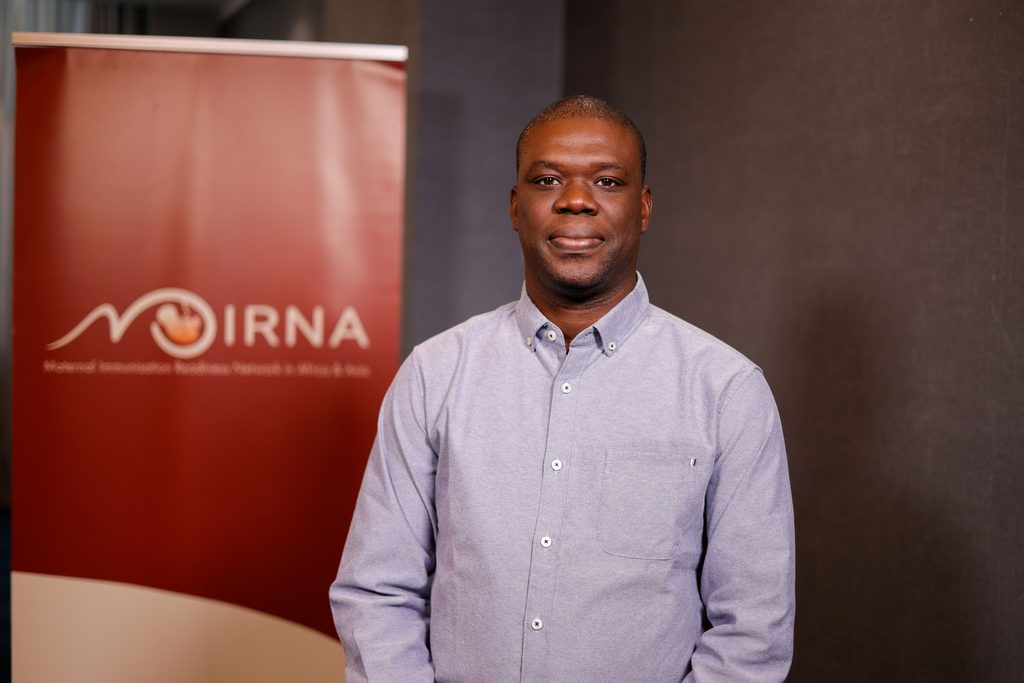
Dr Serge Ouoba earned his medical degree in 2015 and, within a month, had joined the Clinical Research Unit of Nanoro (CRUN), roughly 85 kilometres from Ouagadougou.
Nearly a decade on, that grounding in frontline clinical trial work, spanning malaria drug studies and vaccine research alike, has placed him at the centre of one of Burkina Faso’s most consequential health system exercises: working out whether the country is actually ready to introduce new maternal vaccines against respiratory syncytial virus (RSV) and group B streptococcus (GBS).
Dr Ouoba’s verdict is that Burkina Faso is moderately ready. The country has a working base to build on, and he can name what is missing.
Mapping the system, piece by piece
The exercise, conducted as part of the Maternal Immunisation Readiness Network in Africa and Asia (MIRNA), involved a comprehensive situational analysis of Burkina Faso’s health system. “Burkina Faso has accomplished a situational analysis to see how the country is prepared to introduce new maternal vaccines, especially against RSV and GBS,” Dr Ouoba explained.
The team examined the system domain by domain: human resources, cold chain infrastructure, financing, and policy and governance. Researchers paired the assessment with systematic reviews aimed at understanding how much RSV and GBS actually burden mothers and infants in the country, work that quickly ran into a familiar African health research problem: absent or patchy data.
“Through the systematic reviews, we have found that there’s a lack of data in Burkina Faso, especially for GBS, in order to be able to present to the NITAG so that they can make a decision to introduce the vaccine when it will be ready,” Dr Ouoba said. Without robust local evidence, the National Immunisation Technical Advisory Group, the body ultimately responsible for recommending whether and how a vaccine should be rolled out, has little to work with when the time comes to decide.
To fill that gap in decision-making, if not in data, the team went further. Working alongside the EPI department, they carried out costing analyses to establish what financial outlay a new vaccine introduction would actually require. Community-level assessments followed, probing how pregnant women themselves perceive the prospective vaccines and whether they would be willing to accept them once available.
Bringing the room together
For Dr Ouoba, the technical findings matter, but he singles out something else as the exercise’s defining achievement: assembling, in one process, the full range of actors who would need to move in step for any vaccine rollout to succeed.
“One important point I think we have achieved was bringing together different stakeholders so that they can think about how to better introduce the vaccines in the country,” he said.
That coalition was deliberately broad. Researchers sat alongside officials from the Ministry of Health, specifically the EPI department and the maternal and child health department, together with NITAG representatives and civil society organisations. Collectively, they worked through the bottlenecks obstructing a smooth vaccine introduction and began mapping what would need to change before RSV and GBS vaccines could realistically enter the national schedule.
A qualified verdict: moderately ready
“We have found that the country is currently moderately ready to introduce the vaccine,” Dr Ouoba said of the health system. The strengths he listed next show what that means in practice.
On the positive side of the ledger, Burkina Faso enters this process with real institutional strengths already in place. Its EPI programme functions, and critically, it is already integrated with antenatal care platforms, meaning pregnant women attending ANC visits pass through a system built to deliver immunisation alongside other maternal health services. The country’s NITAG is operational. Cold chain management, essential for keeping vaccines viable from manufacture to injection, is functioning. Adverse events following immunisation (AEFI) are being reported, a sign that surveillance mechanisms exist and are being used.
Yet two weaknesses stood out clearly enough that Dr Ouoba named them as the priorities. “The main bottlenecks are the human resources training and the finance,” he said.
On the human resources front, the shortfall is not merely a matter of headcount, though staffing levels are insufficient. It is also a knowledge gap. Health workers need deeper training not just in delivering a new vaccine, but in understanding the diseases it targets and how maternal immunisation actually works, the biological logic of vaccinating a pregnant woman to protect her unborn or newborn child. “They need to be trained in order to know more about the burden of the disease itself, as well as how the vaccine works when given to the mothers,” he said.
Financing presents the second major hurdle because introducing any new vaccine carries costs well beyond the price of doses themselves: training, cold chain expansion, supply chain logistics and community engagement all require sustained funding. Dr Ouoba was clear that Burkina Faso cannot rely on a single funding stream to meet that challenge. “We think also that in terms of finance, we need to find other ways or several ways to have some resources in order to implement the new vaccines,” he said.
Taken together, Dr Ouoba’s assessment lands on a note that is neither triumphant nor alarmist. Burkina Faso has done the groundwork: it has diagnosed its own system, identified where the data gaps lie, brought its stakeholders into a shared conversation, and named its two biggest obstacles with precision rather than vagueness.
What remains is the harder task of closing those gaps before a vaccine is ready for introduction. “We believe that Burkina Faso is on the way to introduce the RSV vaccine, but there are things that need to be improved, especially when talking about human resources and financing,” Dr Ouoba concluded.
It is a measured assessment from a physician whose career, from sub-investigator on antimalarial trials in Nanoro to a leading voice in MIRNA’s Burkina Faso research, has been built on exactly this kind of unglamorous, methodical groundwork: the sort that rarely makes headlines but ultimately determines whether a vaccine reaches the mothers and infants who need it.