
If you want to understand why some maternal vaccines succeed and others stall before they’ve even begun, Dr Hellen Barsosio has a starting point that might surprise you.
Dr Barsosio a Principal Clinical Research Scientist at the Kenya Medical Research Institute (KEMRI), working alongside the Liverpool School of Tropical Medicine.
She also leads Kenya’s arm of the Maternal Immunisation Readiness Network in Africa and Asia (MIRNA) a nine-country consortium preparing health systems for the introduction of new maternal vaccines. Across those nine countries, one theme keeps resurfacing, a pregnant woman rarely makes a vaccination decision alone.
For a moment, think about a pregnant mother’s mother-in-law, she said.
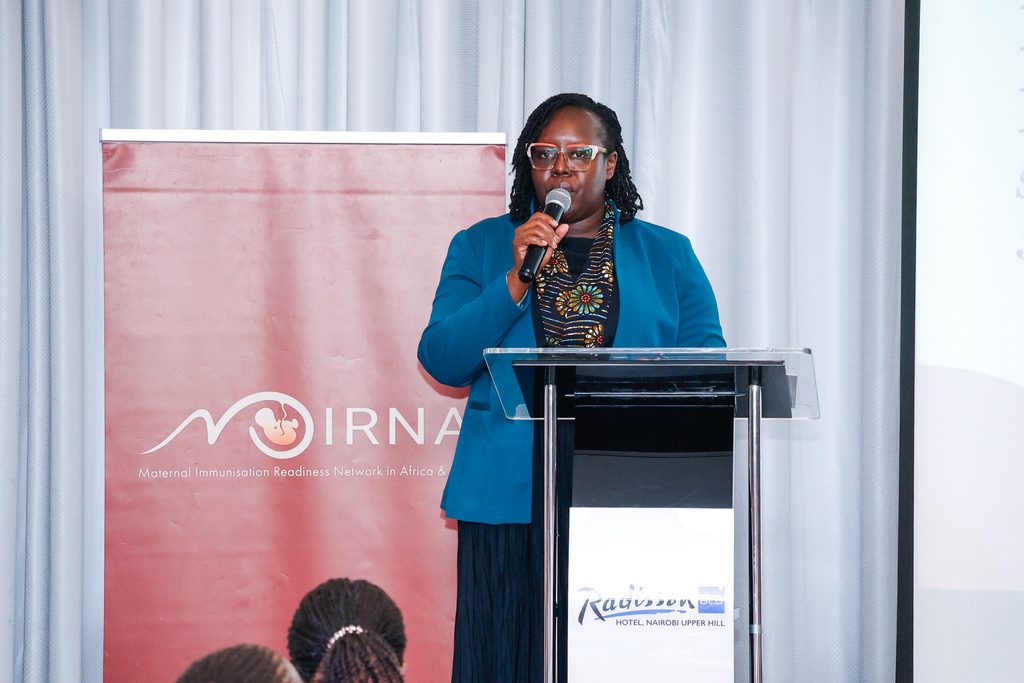
“So, for the members, let their spouses know, their mothers-in-law, their grandmoms that’s how you build trust,” she says. It’s a deceptively simple instruction, but it reframes the entire demand-generation problem. A leaflet handed to a pregnant woman in a clinic waiting room reaches one person. A husband, a mother-in-law and a grandmother who understand and support the vaccine reach the household and, by extension, the wider social network that shapes what that household considers normal and safe.
Behind that observation sits a body of evidence that Dr Barsosio describes as remarkably consistent.
“That’s the clearest evidence that has come from, more than the last five years of new maternal vaccine studies before MIRNA, from ours that women are more likely to take a vaccine if it’s explained to them by a healthcare provider.” It’s a finding echoed by WHO’s own Behavioural and Social Drivers of Vaccination (BeSD) framework, developed with the Strategic Advisory Group of Experts on Immunisation, which repeatedly identifies health workers as among the most trusted sources of information on immunisation anywhere in the world and a provider’s recommendation as one of the single biggest levers on a caregiver’s decision.
But that finding, Dr Barsosio argues, cuts both ways. If trust in the provider is what moves the needle, then building that trust “also means educating providers and supporting providers.” A vaccine demand strategy that pours resources into public messaging while leaving frontline nurses under-informed is building on sand.
This is where Dr Barsosio identifies what she calls the consortium’s central bottleneck. “Our biggest bottleneck at the moment is how knowledge not only the policy knowledge itself, but the knowledge about the vaccine trickling down to providers sometimes takes too long.” And that lag is not a neutral delay. “That knowledge gap and space gap then creates room for misinformation.”
It is a dynamic familiar from Kenya’s own MIRNA health-system readiness data, where facility-level assessments found that immunisation staff typically receive training on childhood vaccines but nothing dedicated to maternal immunisation specifically, leaving inconsistent knowledge of vaccine safety even among vaccinators themselves. The same gap has been documented well beyond Kenya, a systematic review of pre-service immunisation training found that most of the available evidence on preparing health workers for vaccination comes from high-income settings, with far less known about how nurses and vaccinators in lower-resourced systems are, or aren’t, being equipped before they ever see a patient.
Dr Barsosio’s proposed fix is to start earlier and start now. “If we know we have new maternal vaccines on the horizon, let’s introduce it in the curriculums right now in nursing schools, in medical schools. They come out knowing about it.” She said adding that: “So when it’s implemented, say two years or five years down the pipeline, they’ll know about it.”
Kenya has already piloted precisely this approach with routine childhood immunisation. Kenya Medical Training College, working with WHO’s Regional Office for Africa and international partners, revised its nursing and midwifery curricula to build immunisation content directly into pre-service training, using prototype curricula that WHO first developed for the African region and updated in 2015. The rationale is what Dr Barsosio applies to maternal vaccines now which she says is far easier to graduate a workforce that already understands a new vaccine than to retrain one after the fact, under pressure, once a rollout is already under way.
Even a well-trained provider, though, runs into a second, more mundane obstacle, time. “Empower the nurses,” Dr Barsosio says. “Our clinics are really full. I think we’ve heard from some of our health systems data you have one nurse who delivers all of these interventions. She’s overworked, meaning that time for counselling is quite thin.”
That single overstretched nurse is a recurring image across MIRNA’s country findings from Kenya’s own facility assessments to Burkina Faso’s account of ANC sessions so overcrowded that “on vaccination day they don’t have time to answer your questions.” However strong a provider’s knowledge, Dr Barsosio’s point is that knowledge cannot substitute for the minutes required to actually deliver it.
Her solution is to widen the circle of trusted messengers rather than pile more onto the same nurse. “It could be a group talk before the beginning of services at the day. It could be supplementing support like using lay healthcare workers, like community health volunteers or community health promoters to be able to supplement how that information is delivered, with the support of nurses, for instance, or support of vaccinators.”
WHO views task-shifting more broadly as a viable way of improving healthcare coverage by making fuller use of the workforce that already exists, and community health workers have been shown, in settings from Malawi to Burkina Faso, to take on real demand-generation duties running health talks, mobilising communities, fielding questions and dispelling myths precisely the counselling load that would otherwise fall entirely on a single vaccinator.
As Dr Barsosio puts it, the goal is simply “building the pool of more trusted sources who can give this information.”
Vaccine confidence in Bangladesh, Kenya, Nigeria and everywhere else MIRNA has looked is manufactured through campaigns and also inherited through relationships between a woman and her mother-in-law, between a patient and a nurse she has known for years, between a health system and the public it has or hasn’t earned the confidence of.
Dr Barsosio’s contribution is to insist that none of those relationships can be left to chance. Providers must be taught early, supported properly, and given the time, or the reinforcements, to actually talk to the women in front of them. Get that right, she suggests, and the mothers-in-law and grandmothers will follow.