

When Dr Eve Nakabembe talks about infant death in Uganda, she uses a sentence that mothers themselves say: “I came expecting a baby, I went back with silence.”
That sentence explains why Uganda’s contribution to the MIRNA Consortium is built as much around community voices as around laboratory data. Dr Nakabembe, a senior obstetritician-gynaecologist, vaccinologist and clinical researcher at Makerere University’s College of Health Sciences is also part of MIRNA team in Uganda.
MIRNA, the Maternal Immunisation Readiness Network in Africa and Asia, brought researchers from nine countries to Nairobi to compare progress in preparing health systems and communities for new maternal vaccines against respiratory syncytial virus (RSV) and group B streptococcus (GBS). Uganda’s presentation stood out for combining hard epidemiological evidence with a clear strategy for earning the trust of both ministers and communities.
A natural defence, strengthened
Dr Nakabembe presents maternal immunisation as something the body already does. Pregnant women are exposed to bacteria and viruses circulating in their communities, and their bodies respond by producing antibodies. Those antibodies cross the placenta, arming the baby before birth and protecting it through the first, most vulnerable weeks of life.
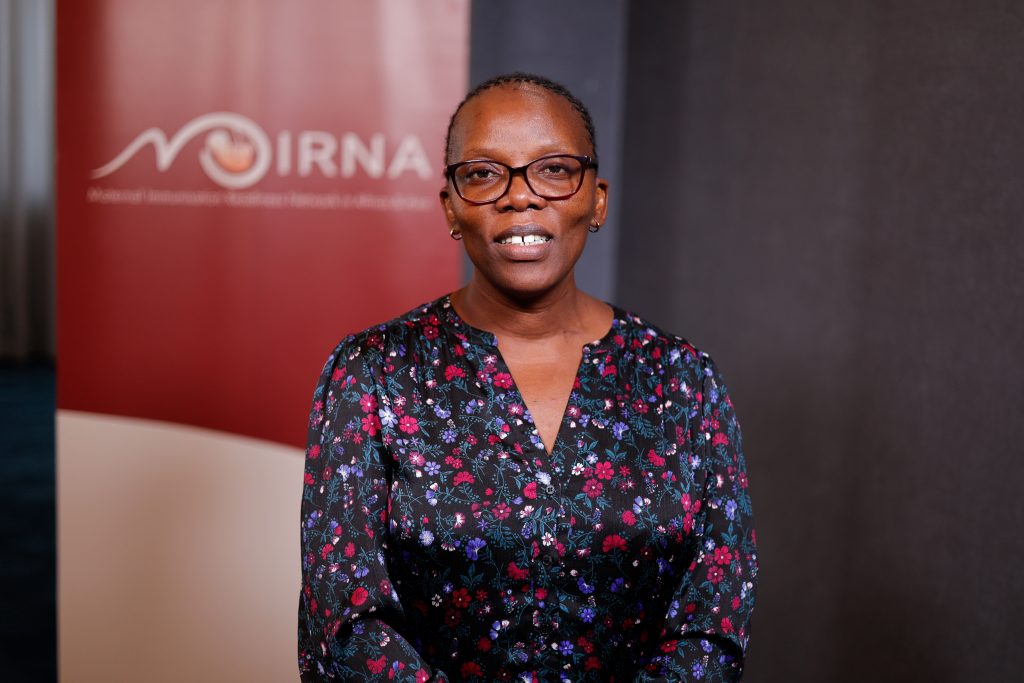
“Maternal immunisation uses that natural phenomenon to literally boost the mother’s ability to protect her baby in the womb and in early infancy,” she explains, “especially under three months and under six months, from severe infections.”
Proving the problem is real
Dr Nakabembe is candid about where any vaccine conversation must begin. “If you’re going to give any mother any vaccine, the first question is: what vaccine are you giving me? What are you protecting me against? Am I vulnerable? Is it a problem where I am?”
Before Uganda could discuss rollout, it had to show that the problem existed at home. The proof came from the country’s RSV burden-of-disease work, led by a team drawing on modelling by Young, Cheliotis and Mukasa. A literature search from inception to January 2025 identified about 305 records. Screening narrowed these to five published studies, which were supplemented by richer unpublished surveillance data. The studies span 2012 to 2024 and consistently used nasopharyngeal swabs and PCR testing.
The findings were strong enough to reach Uganda’s National Immunisation Technical Advisory Group (NITAG) and the Ministry of Health directly, under a newly appointed minister:
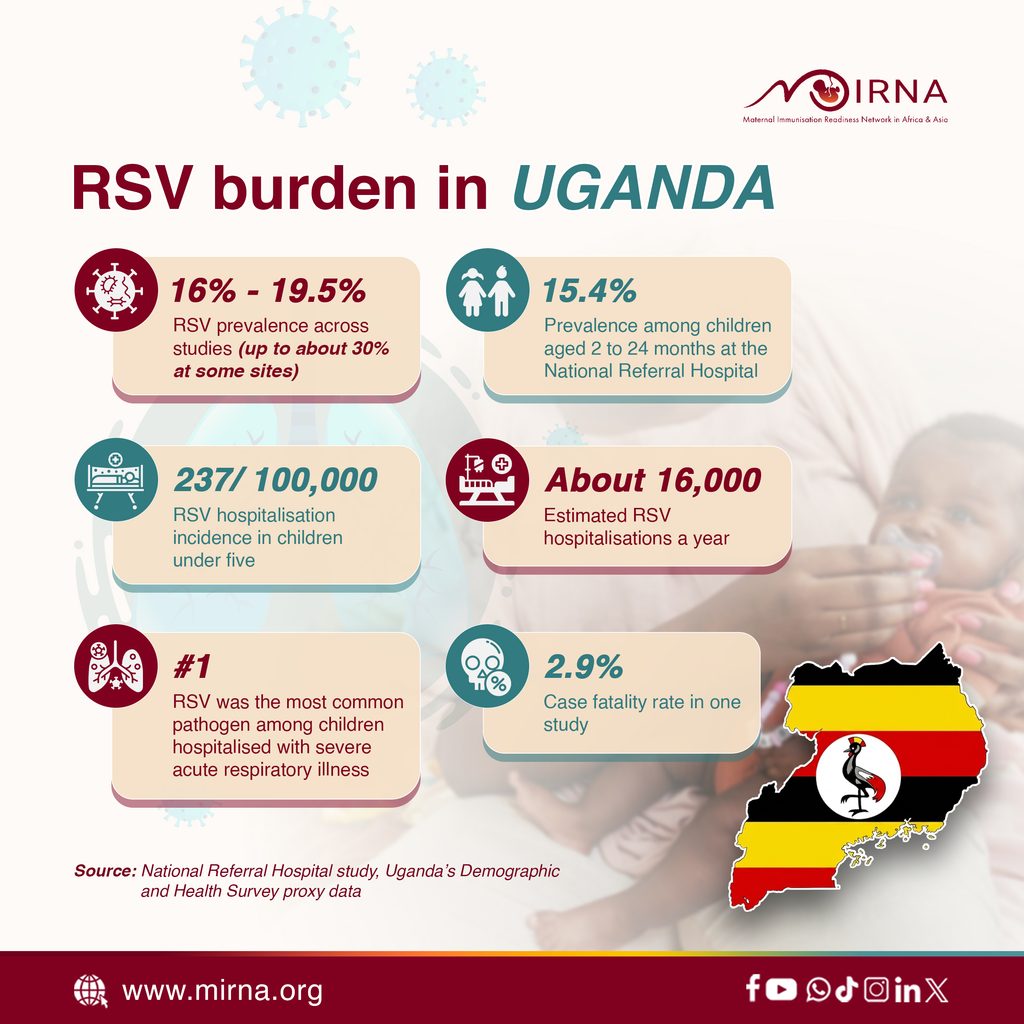
- Prevalence: RSV prevalence across the studies ranged from roughly 16 to 19.5 percent, and in some sites approached 30 percent. A study at the National Referral Hospital, covering children aged two to 24 months, found a prevalence of 15.4 percent.
- Hospitalisations: Modelling based on Uganda’s Demographic and Health Survey proxy data estimated an RSV hospitalisation incidence of 237 per 100,000 children under five, or roughly 16,000 hospitalisations a year.
- Deaths: One study recorded a case fatality rate of 2.9 percent.
- Dominance: RSV was the most common pathogen among children hospitalised with severe acute respiratory illness.
Dr Nakabembe counts generating this evidence among Uganda’s biggest achievements, particularly because the tests needed to confirm RSV are expensive and rarely available in routine care. Her team focused on children under 90 days with lower respiratory tract infection, examining both RSV and GBS because, she says, “those are the new vaccines on the horizon.”
The work went beyond prevalence counts to characterise the serotypes circulating locally. A vaccine, she says, “should be able to target not only the bacteria or the virus but the type of bacteria and virus that is circulating in our setting.”
Listening to the minister
The minister’s advice shaped how the data was framed. He asked the team to highlight the burden among children under two and to pair epidemiology with practical cost information, such as the cost of keeping a child on oxygen in the neonatal intensive care unit.
NITAG’s feedback was largely positive on the statistical strength and low heterogeneity of the data. It initially asked for more detail on seasonality and geography, gaps the team says it has since closed. The minister and NITAG then jointly steered the country away from a monoclonal antibody approach and towards maternal vaccination.
Building a safety baseline
Safety cannot be judged in a vacuum. “You cannot know if the vaccine is safe or not safe if you don’t have your background characteristics,” Dr Nakabembe says. Researchers first need a clear record of pregnancy outcomes before any vaccine is introduced. Her team has documented these outcomes in advance, creating a baseline against which safety monitoring can be compared once maternal RSV and GBS vaccines arrive.
What mothers think
Uganda’s vaccine demand research was led by Dr Agnes Ssali of Makerere University, with Professor Annet Nakimuli, Professor Kirsty Le Doare and Dr Nakabembe. It surveyed 300 women at two contrasting sites 135 kilometres apart: urban Kawempe in Kampala and rural Iganga.
Health workers were the most trusted source and the one most often cited as recommending vaccination. Seeing other women vaccinated safely was also a powerful motivator. Of the 300 women, 257 rated vaccinating the baby as very important, and 249 said they trusted health workers.
A smaller group wanted more information before feeling fully confident. Access, particularly distance and transport in rural Iganga, remained a real barrier.
Dr Nakabembe insists that capturing community perception was no side issue. “We may do all this robust genomic scientific research and the guys are like, no, no, no, a vaccine is witchcraft,” she says. In her account, gathering the views of communities and stakeholders mattered as much as the laboratory work.
Don’t forget the fathers
Dr Sabrina Kitaka, a Ugandan paediatrician and NITAG member, noted that Uganda now delivers fourteen childhood vaccines and that mothers increasingly ask how many more are needed. She sees this as an early sign of hesitancy, which she framed through the classic “three Cs”: convenience, complacency and confidence.
She was equally direct about who gets left out. “Fathers have to be part of it. We always leave out the fathers in the discussion,” she said, calling for religious and cultural leaders to be engaged directly rather than as an afterthought.
Dr Kitaka also suggested humanising the statistics for ministers by framing the toll starkly, for instance that roughly three babies die every second from a preventable disease. The aim is to build an emotional case as well as an evidentiary one.
More than a publication count
For Dr Nakabembe, the true measure of MIRNA’s work is a shift in how families experience pregnancy.
“I really hope that first of all MIRNA can change that broader narrative,” she says. “We are mothers, and I always think their babies survive.”
Her closing reflection captures the stakes better than any figure in the dataset: “I hope that through all this science, MIRNA can demystify infant deaths through vaccination, so that mothers get to know that children can survive when their mothers receive vaccines in pregnancy.”
Uganda’s contribution to MIRNA is three projects in one: proving the problem is real, proving that any future vaccine will be safe, and proving to sceptical communities and busy ministers alike that the evidence deserves their trust.
Data at a glance:
The evidence base
- 305 records screened, narrowed to 5 published studies (2012 to 2024), plus unpublished surveillance data
- Testing method: nasopharyngeal swab and PCR
- Literature search ran from inception to January 2025
RSV burden in Uganda
- 16% to 19.5%: RSV prevalence across studies (up to about 30% at some sites)
- 15.4%: prevalence among children aged 2 to 24 months at the National Referral Hospital
- 237 per 100,000: RSV hospitalisation incidence in children under five
- About 16,000: estimated RSV hospitalisations a year
- 2.9%: case fatality rate in one study
- #1: RSV was the most common pathogen among children hospitalised with severe acute respiratory illness
What mothers think (survey of 300 women)
- 257 of 300 (about 86%) rated vaccinating the baby as very important
- 249 of 300 (about 83%) said they trusted health workers
- 2 sites, 135 km apart: urban Kawempe (Kampala) and rural Iganga